
Problem-Solving Courts
All Nebraska Drug and other Problem-Solving Courts are governed by the Nebraska Supreme Court Committee on Problem-Solving Courts under the direction of the Nebraska Supreme Court. Members include representatives of courts, probation, law enforcement and the legal community along with judges, prosecutors and defense attorneys.
Nebraska Problem-Solving Courts are an institution of the Nebraska Supreme Court utilizing innovative court programs through which individuals and families thrive, and all Nebraska communities become safer.
Nebraska problem-solving courts operate within the district, county, or juvenile courts in all 12 Nebraska Judicial Districts. Most problem-solving courts in Nebraska operate under the Administrative Office of the Courts and Probation (AOCP), with the exception of the Adult Drug Courts in Douglas and Lancaster Counties. Family Treatment Courts (FTC) typically operate within both the Courts and the Department of Health and Human Services. Problem-Solving Courts are post plea or post-adjudicatory intensive supervision treatment programs designed for high risk and high need individuals. Nebraska Problem-Solving Courts can only be established with the approval of the Nebraska Supreme Court. Problem-solving courts reduce recidivism and increase community safety through a comprehensive and coordinated court response utilizing early assessment and intervention, individualized treatment, intensive community supervision and consistent judicial oversight. All Nebraska problem-solving courts adhere to established standards. Nebraska problem-solving court models include Adult Drug and DUI Courts, Veterans Treatment Courts, Reentry Courts, Juvenile Drug Courts, Young Adult Courts, Mental Health Courts, and Family Treatment Courts.
Nebraska Problem-Solving Courts operate under a team approach where a judge, prosecutor, defense counsel, coordinator, community supervision officer, law enforcement, and treatment provider(s) work together to design an individualized program. Compliance with treatment and court orders is verified by frequent alcohol/drug testing, community supervision, home and field visits, and frequent interaction with a Judge in non-adversarial court review hearings.
Problem-Solving Courts Authorization, Rules and Legislation
- Nebraska Revised Statute 24-1301 (Problem-Solving Courts-alternative to incarceration in Nebraska.)
- Nebraska Revised Statute 29-2246 (Authorized probation personnel to operate Problem-Solving Courts.)
- Nebraska Revised Statute 24-1301 and 24-1302, and section 29-2246 (Expand definition of Problem-Solving Courts to include Veterans Treatment Courts, Mental Health Courts, and Reentry Courts in Nebraska.)
- Nebraska Supreme Court Rules § 6-1201 et seq. (Rules on Problem-Solving Courts.)
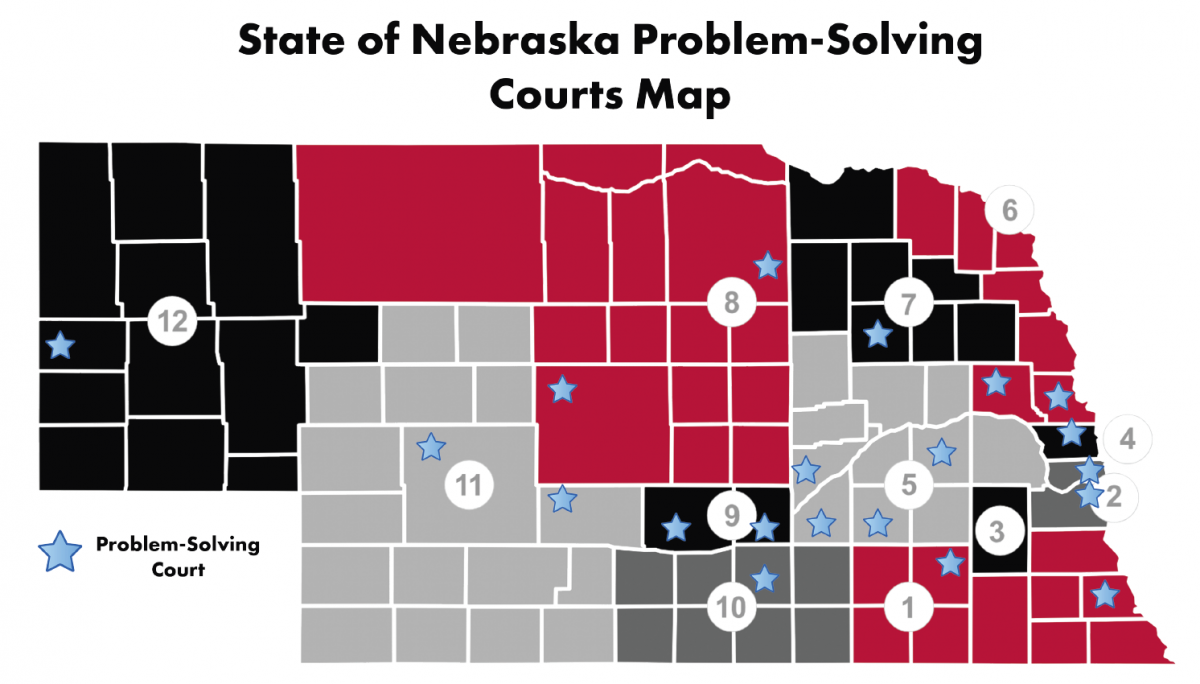
Click on the above map of locations to enlarge.
Contact:
Adam Jorgensen, Statewide Problem-Solving Court Director
521 S. 14th St., Ste.101
Lincoln, NE 68508
adam.jorgensen@nejudicial.gov
402.471.4415